

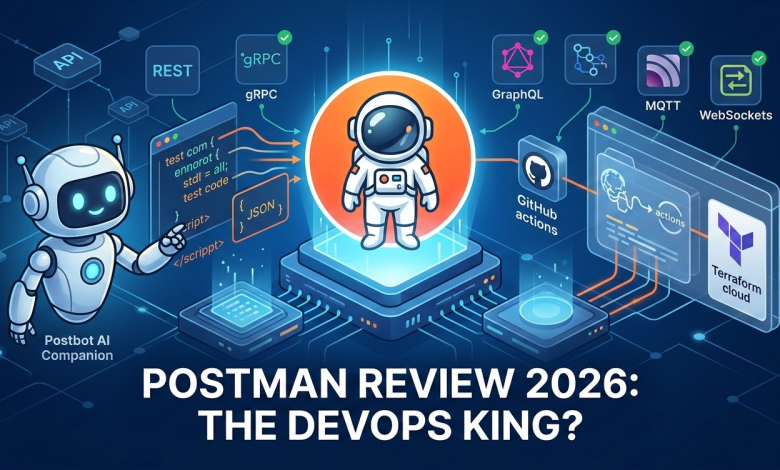
In this deep-dive review, we analyze whether Postman has maintained its lead or become a “bloated legacy” in the age of automated, AI-driven development.
1. The 2026 Evolution: From Request Sender to AI Powerhouse
The Postman of 2026 is unrecognizable from its predecessors. The headline feature this year is the Postman AI Companion (Postbot), which has evolved from a simple script generator to a proactive architect.
- Predictive Testing: Postbot now analyzes your API schema and automatically generates a 95% coverage test suite, including edge cases like SQL injection attempts and boundary value failures.
- Natural Language to Workflows: You can now type “Chain a login request to get a token, then use it to fetch user profile data and validate the JSON schema,” and Postman will build the entire collection and environment variables for you.
2. Advanced Features for Modern Architectures
If you are managing complex infrastructure, Postman’s 2026 updates provide critical utility across multiple protocols:
A. Multi-Protocol Sovereignty
REST is just the beginning. Postman now offers tier-one support for:
- gRPC & Protobuf: Essential for high-performance Microservices.
- WebSockets & WebHooks: For real-time event-driven architectures.
- MQTT: A must-have for developers working in IoT (Internet of Things).
- GraphQL Introspection: Dynamic query building with full schema visualization.
3. The DevOps Bridge: Postman in the Cloud Infrastructure
For a Cloud Engineer or DevOps Specialist, a tool is only as good as its integration into the CI/CD pipeline. This is where Postman dominates in 2026.
Infrastructure as Code (IaC) & Terraform Integration
Postman now allows you to export environment variables directly into Terraform (.tfvars) or Kubernetes ConfigMaps. This ensures that your API endpoints, secrets, and metadata remain consistent from your local testing environment all the way to your Azure or AWS production clusters.
GitHub Actions & Automated Governance
Using the Postman CLI, you can set “Governance Gates” in your GitHub Actions. For example:
“Stop the build if the API response time exceeds 200ms or if the security headers (HSTS, CSP) are missing.”
This shift-left approach to API quality ensures that performance bottlenecks are caught long before they reach the user.
4. Postman vs. The Competition: A 2026 Comparison Matrix
| Feature | Postman (2026) | Insomnia | Thunder Client |
|---|---|---|---|
| AI Integration | Advanced (Postbot) | Moderate | Limited |
| Protocol Support | REST, gRPC, MQTT, Ws | REST, GraphQL | REST Only |
| Resource Usage | High (RAM Intensive) | Medium | Low |
5. The Verdict: Is Postman Still Worth It?
If you are a solo developer doing quick hobbyist projects, a lightweight tool like Hoppscotch might be enough. However, for Cloud Engineers and Enterprise Teams building resilient, scalable systems, Postman is still the gold standard.
Its ability to bridge the gap between “it works on my machine” and “it’s production-ready” remains unparalleled in 2026.
Verdict: A must-have for professional API lifecycles
